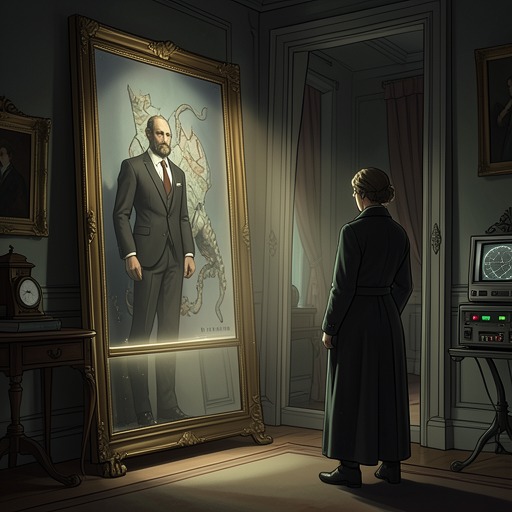
Imp-Reflecting Mirror Identification and Warning Rule
The Portable DoorThe Imp-Reflecting Mirror Identification and Warning Rule makes reflection a working test of magical disguise: a being whose shape has been changed by magic appears as what it really is. Demonstrated when Dietrich Wurmtoter showed Paul Carpenter the captive Kurt Lundqvist, the rule turns an ordinary-looking mouse into evidence of a hidden human form—and treats the absence of any reflection as a reason to flee.
How the Mirror Identifies a Transformation
Dietrich Wurmtoter first invited Paul Carpenter to look at Kurt Lundqvist directly, then at the image beneath the mouse’s paws on a polished tabletop. The reflection showed not a mouse but a tiny man in combat fatigues and top-of-the-range Ray-Bans, carrying a one-thirty-second-scale Kalashnikov and scrabbling against the wood. The contrast established the mirror’s practical distinction: the visible shape could be magical, while the reflected one disclosed the transformed being’s true form.
Wurmtoter described imp-reflecting mirrors as a Chinese invention and said they could be attached to almost anything. The tabletop served as one such surface, showing that the identification rule did not depend on a separate handheld mirror. The device makes reflection useful not merely for checking appearances but for detecting the magical alteration that ordinary sight conceals.
Use in Negotiation and Caution
The firm had installed an imp-reflecting mirror on its boardroom table. Wurmtoter explained that seeing the true forms of opponents’ negotiating team could be useful when facing the other side across the table. In that setting, the mirror functions as a practical safeguard: it can reveal that a seemingly ordinary participant has been changed by magic before appearances are taken at face value.
The rule also has a limit with a sharper consequence. Wurmtoter warned that some beings do not show up in the mirror at all and advised running away very quickly if one is encountered. The mirror therefore supplies two different signals: a revealed true form identifies a magical transformation, while total absence from the reflection marks a threat for which the recommended response is escape.
Significance
The rule turns a familiar act—checking a reflection—into a test of appearance against magical reality. Kurt Lundqvist’s reflected human form makes the difference concrete, while the boardroom use extends the test from an individual demonstration to the firm’s negotiations. Yet the warning prevents the mirror from becoming a guarantee of safety: it can expose some concealments, but its most alarming result is a reflection that is not there.